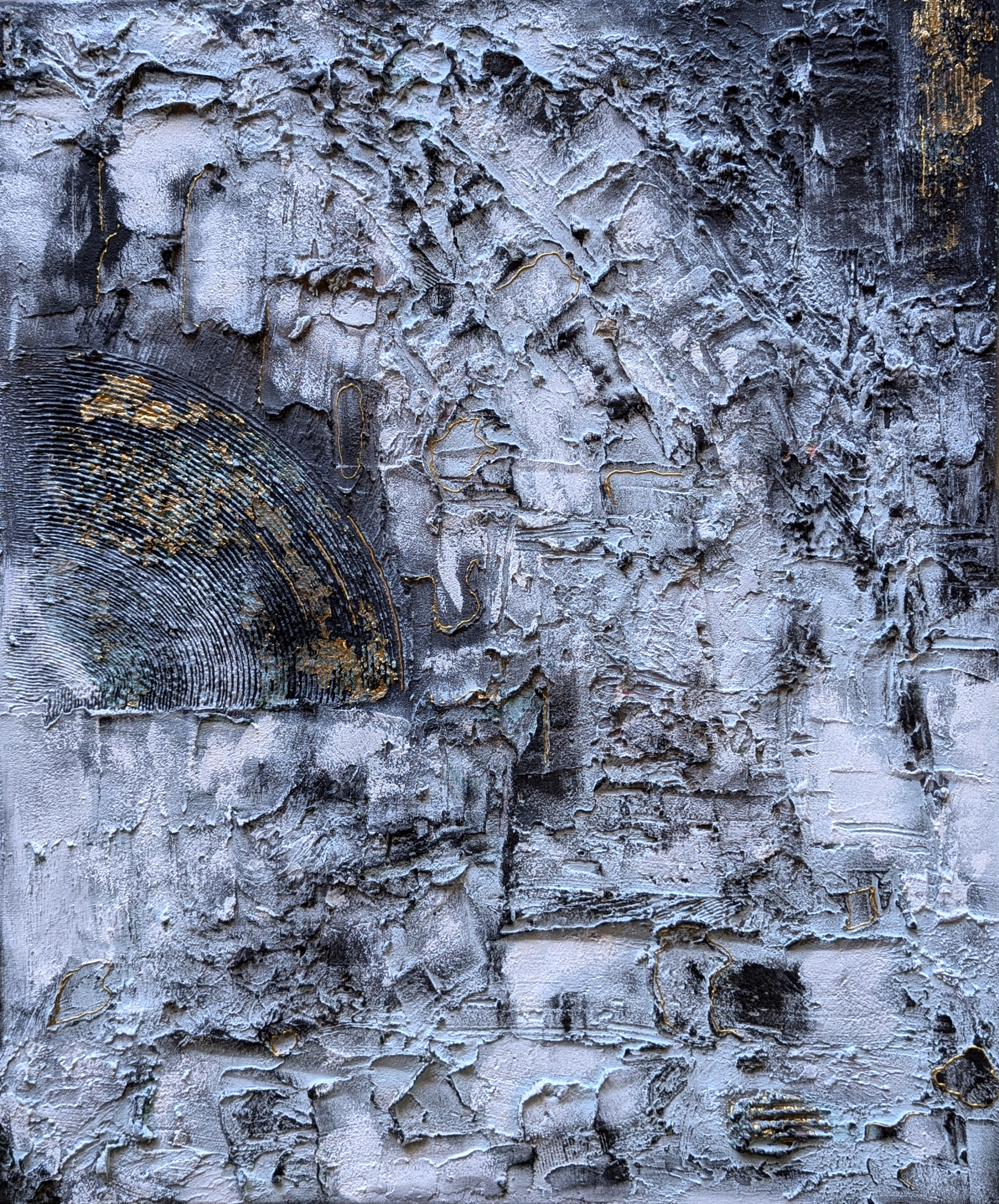
Art has always been my way of making sense of the world, of channeling emotions and stories into something tangible. But there’s something especially profound when my hands work with textures, when I can feel the roughness under my fingers, knowing that each ridge and groove holds a story. This painting, which I’ve named “Echoes of the Steppe,” feels like one of the most personal pieces I’ve created. It was born out of my desire to capture the essence of my Kazakh heritage — its landscapes, its history, and the way it continues to shape me even after I’ve left.
I was born in Taraz, one of the oldest cities in Kazakhstan. The ancient walls and winding streets hold centuries of history. Growing up, I felt a connection to the stories that came before me — tales of nomads, conquerors, and survivors. The vast steppe, which surrounds so much of Kazakhstan, always felt like an extension of those stories: endless, wild, and full of potential. The Kazakh steppe is a land that doesn’t just exist in the present but seems to echo with the past. When I create textured art, I try to capture those echoes — the layers of history, the resilience of my people, and the quiet beauty that comes from a harsh but enduring land.

The Cultural Roots:
Kazakhstan is a country with deep ties to its landscape, and for many Kazakhs, the land itself is a part of their identity. The endless plains of the steppe, the rugged mountains in the east, and the ancient Silk Road that once crossed through cities like Taraz are not just geographic features but cultural markers. They speak to the nomadic spirit of our ancestors, people who lived in harmony with the land, moving with the seasons, building their lives in a place both unforgiving and abundant.
The textures in “Echoes of the Steppe” reflect this history. The rough surfaces represent the challenges of living in such an environment, where survival was not guaranteed but was earned through perseverance and strength. The worn, broken lines mirror the ancient paths walked by our nomadic ancestors, who roamed these vast landscapes with a deep respect for nature. In these textures, I see the Kazakh spirit — a spirit that is strong, resilient, and unyielding.
But the painting also has moments of softness, areas where the texture smooths out, much like the quiet beauty of a Kazakh summer evening, when the land turns golden in the light of the setting sun. It’s in these contrasts — the harsh and the soft, the rough and the smooth — that I see my homeland.
Art as a Journey:
When I began working on this piece, I thought not only about Kazakhstan’s landscapes but also about my personal journey. I’ve walked a long road to where I am now, both literally and metaphorically. Leaving my home, leaving Kazakhstan, was one of the hardest things I’ve ever done. But it was necessary to follow my passion for art without restrictions, to explore my creativity fully.
As I built the layers of plaster, I was reminded of the layers of my own life, how every experience — both the good and the bad — has shaped me. The plaster became a metaphor for my own resilience. Each application felt like a small act of defiance, a way of saying that no matter how rough things get, I will continue to build, to create, to move forward.
The touches of gold leaf in this piece are not just for decoration. They symbolize the moments of beauty that can be found in even the most difficult of times. When I think of my homeland, I think of both the challenges — the cold winters, the isolation of the steppe — and the beauty that emerges in the smallest details: the way the light hits the land at dawn, the sound of the wind moving through the grass, the endless horizons that make you feel both small and infinite. This duality is what I tried to capture in the painting.
Themes of Reflection and Resilience:
At its core, “Echoes of the Steppe” is a reflection on resilience. The painting is textured, uneven, and complex, much like life itself. It asks the viewer to take a closer look, to find meaning in the cracks and rough edges. I’ve always believed that true beauty comes from these imperfections. Our struggles, our challenges, the obstacles we face — they shape us into who we are. This painting is my story, but it is also a universal story.
In Kazakhstan, we have a saying:
Ер жігіт ел үшін туады, ел үшін өледі.
The wind of the steppe does not bow the head of the strong.
I think about this often when I create. The steppe, with all its harshness, can be unforgiving. But it can also be a place of immense beauty, if you know how to look for it. Just as our ancestors adapted to the land, finding ways to live and thrive in a difficult environment, so too do we find ways to adapt to our circumstances, to overcome the difficulties in our own lives.
I hope that when people look at “Echoes of the Steppe,” they see more than just a painting. I hope they see a reflection of their own lives, their own challenges, and their own resilience. The rough textures might remind them of the difficult moments they’ve faced, while the gold leaf could be a symbol of the beauty and strength they’ve discovered along the way.
I created “Echoes of the Steppe” as a way of connecting my past with my present, of bringing the essence of Kazakhstan into the spaces I now occupy. It’s a deeply personal piece, but I believe it speaks to something universal. We all carry with us the textures of our lives — the rough patches, the smooth moments, the unexpected flashes of beauty. And just as this painting invites you to contemplate its textures and layers, I hope it invites you to reflect on your own journey.
In the end, this is more than a painting. It’s a meditation on resilience, on the way our past shapes our present, and on the beauty that can be found in the most unlikely places. Whether you’re from Kazakhstan or anywhere else, I hope this piece resonates with you and encourages you to think about the textures of your own life — and how they make you who you are.