In the heart of Central Asia, where the Earth stretches out in an endless embrace of sky and land, there lies a canvas of history painted by the winds of the steppe. This is where our story begins, in the ancient land of Kazakhstan, with a woman whose eyes held the depth of the Caspian Sea and the fierceness of the winter blizzard.
Her name was Aizere, which in the melodic language of her people means “moonlight.” It was a name befitting her luminous presence, a name whispered by the steppe as if she were born from its very soul. Aizere was a descendant of nomads, carriers of traditions that danced with the flames of the evening fire. Yet, within her chest beat a heart torn between the ancestral call of the dombra and the silent hum of the digital age.
As a child, Aizere’s playground was the vast steppe, a kingdom of green in summer and an empire of white in winter. She was taught to respect the spirits of the land, to listen to the stories carried by the wind, tales of courage, love, and the wild freedom that once ruled her people’s destiny. Her grandmother, a sage adorned in robes of wisdom, would recount legends that made Aizere’s imagination soar like an eagle upon the thermals. And in those moments, a spark ignited within her—a burning desire to capture these stories, to paint them into being.
But the steppe could not contain Aizere’s dreams. She longed to explore, to learn, and with a heart heavy with both excitement and sorrow, she left for the city. The transition was like stepping into another world—a cacophony of sounds, a kaleidoscope of sights, a mosaic of possibilities. The city pulsed with life, a rhythm so different from the heartbeat of the steppe. It was here that Aizere encountered the paradox of modernity, a place where traditions were cherished yet often overshadowed by the allure of the new.
In the city’s embrace, Aizere discovered a new medium—digital art. It was a revelation, a bridge between the worlds she lived in. With a tablet as her canvas and a stylus as her brush, she began to create. Each stroke was a word in the story she was telling, each color a note in the song of her heritage. She painted yurts under the celestial dance of the auroras, warriors of old with eyes mirroring the steppes’ vastness, and the everyday life of her people, vibrant and enduring.
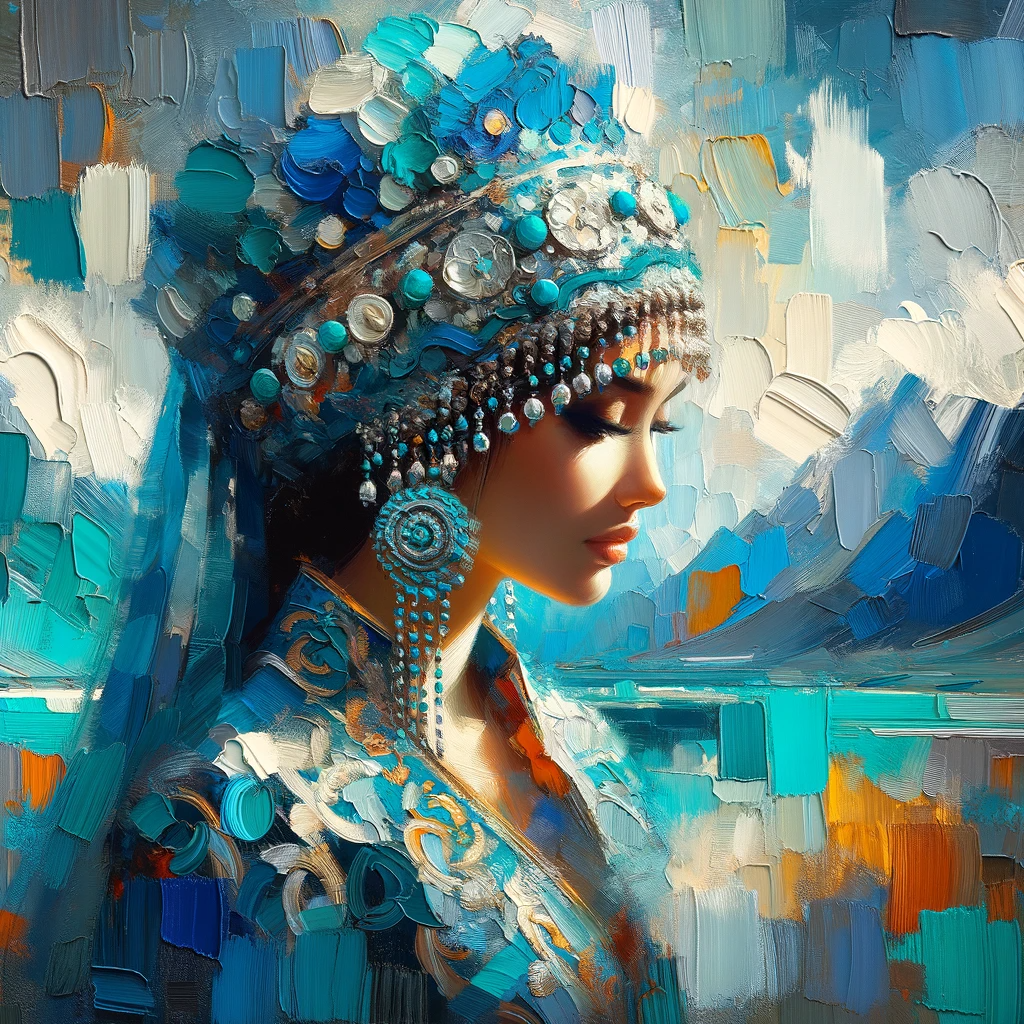
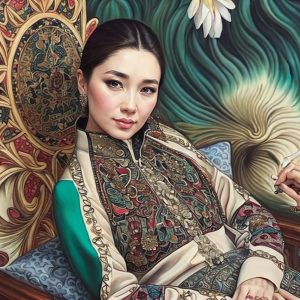
The portrait you see, the one imbued with the essence of the Kazakh soul, was born from Aizere’s deepest reflections. The woman in the painting, with jewels of her lineage and a gaze that challenges the observer, is Aizere’s tribute to the matriarchs of her family. Through her, she channeled the strength of her grandmother, the resilience of her mother, and the hopes of her sisters.
The creation of the portrait was a journey of introspection. Aizere would often pause, step back, and lose herself in the woman’s eyes, finding pieces of her identity staring back at her. It was through this silent communion that Aizere reconciled the duality of her existence, affirming that one could walk in the new world while carrying the old world within.
The day of the exhibition arrived like the dawn after a long night. The gallery was a crucible where the past and present merged. People from all walks of life—elders from the steppe in their traditional attire, young Kazakhs from the city with eyes wide with wonder, art enthusiasts who spoke the language of beauty—gathered to witness Aizere’s vision.
As they stood before the portrait, emotions stirred in the air—a mixture of pride, nostalgia, and an understanding that transcended words. Aizere’s artwork, especially the digital painting of the Kazakh woman, became a mirror for each onlooker, reflecting their own stories, their own struggles, and their own dreams.
In the “Eyes of the Steppe,” they saw not just a woman, but the soul of Kazakhstan—a land of enduring beauty, a people of unbreakable spirit, and the journey of one artist who dared to capture the heart of her culture in a symphony of pixels and light.